

Destination guide · Philippines
Plongée à Camiguin
Camiguin’s volcanic character continues underwater, from dark slopes to reefs around offshore islands. A diving day can be followed by waterfalls, springs or a view of the mountains, making the island unusually rewarding for a mixed holiday.
Photo: Bo Mancao / Scuba de Oro
Camiguin en un coup d'œil
Le caractère volcanique de Camiguin se poursuit sous l'eau, des pentes sombres aux récifs autour des îles au large. Une journée de plongée peut être suivie de cascades, de sources ou d'une vue sur les montagnes, ce qui rend l'île particulièrement intéressante pour des vacances variées.
Planifier votre séjour à Camiguin
Choisissez un point de chute côtier offrant un accès pratique à la fois aux sites volcaniques locaux et aux excursions en bateau à Mantigue ou dans d'autres zones au large. Quatre à six nuits permettent de partager les vacances entre plongée et exploration terrestre, plutôt que de ne visiter les cascades qu'en fin de séjour.

Balai sa Baibai & Coraya Divers Camiguin
Resort boutique de sept chambres en bord de plage à Mambajao, avec Coraya Divers sur place, encadrement en petits groupes au ratio guide/plongeurs de 1:4 et plongées flexibles sur les récifs de Camiguin, les sites macro et...

Scuba de Oro Camiguin
Centre de plongée indépendant à Camiguin, proposant des forfaits de 2 ou 3 plongées à la journée, un spacieux bateau de plongée de 15 m, un accompagnement personnalisé et l'accès à Mantigue Island, aux récifs volcaniques, ...
Liveaboard routes for this destination
Explore the routes that visit this region. Compare ships and itineraries, then open a route to see its sailing dates, cabins and the areas it covers.
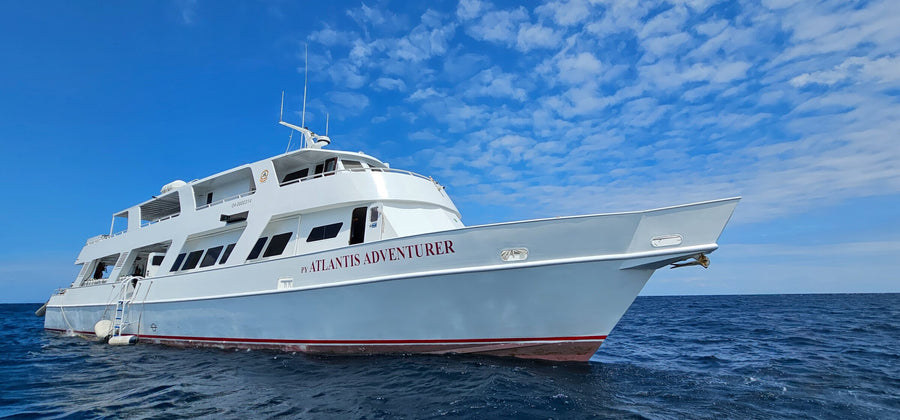
Atlantis Adventurer
safari à Camiguin
- Indicative duration
- 7 nights
- Embarquement
- Atlantis Dumaguete Resort, Dauin
- Débarquement
- Atlantis Dumaguete Resort, Dauin
No routes match this search. Try another vessel or clear your search.
Quand plonger à Camiguin
La plongée est possible toute l'année. La direction du vent, les précipitations et le côté de l'île choisi influencent le programme de chaque journée, il convient donc de prévoir de la flexibilité entre les sites côtiers abrités et les récifs au large. Cette variété fait partie de la richesse de Camiguin.
Période de planification : plongée toute l'année.
À quoi ressemble la plongée
Choisissez les îles et les sites en fonction de l'expérience du groupe.
Récifs de l'île de Mantigue
Les récifs frangeants, les pentes coralliennes, les tortues et les bancs de poissons font de Mantigue la journée classique de plongée et de snorkeling de l'île, pour tous les niveaux.
Shoal de Burias
Un récif immergé avec des pentes, des sections de mur et des bancs de poissons, offrant une sensation de plongée en eau bleue plus prononcée que celle de nombreux sites côtiers de Camiguin.
Paysages sous-marins volcaniques
La lave ancienne, les formations rocheuses, les pentes raides et la croissance corallienne autour du Vieux Volcan et du Cimetière Englouti racontent sous l'eau l'histoire géologique de Camiguin.
Corail noir et jardins coralliens
White Island et d'autres sites combinent jardins coralliens, habitats de corail noir et poissons de récif avec des vues spectaculaires sur Camiguin au-dessus de la surface.
Photographie macro et grand-angle
Les tortues, les bancs de poissons et les scènes de récif récompensent les photographes grand-angle, tandis que les nudibranches, les poissons-grenouilles, les poissons-scorpions, les crevettes et d'autres sujets plus petits offrent de la variété aux photographes macro.
Temps de surface à White Island et Mantigue
La langue de sable de Camiguin et son parc insulaire protégé offrent d'excellentes pauses de surface, des occasions de snorkeling et de photographie pour les plongeurs comme pour les non-plongeurs.
Plongée en petits groupes
Camiguin convient aux plongeurs individuels, aux couples et aux petits groupes privés qui préfèrent une sélection de sites flexible et un rythme insulaire plus calme.
Volcans, sources et cascades
Hibok-Hibok, les cascades, les sources chaudes et froides et les sites patrimoniaux transforment les jours de repos entre deux plongées en une partie intégrante de l'expédition, plutôt qu'en un simple temps hors de l'eau.
DIVE SITE GUIDE
Dive sites in Camiguin
Explore the character of individual sites, from the setting and marine life to the diving conditions. Open a card for the full description; site access and the final profile depend on conditions and experience.
ORIENTATION MAP
Where the dive sites are
Use the map to understand how the key sites are spread around the destination. Pins are for trip-planning orientation only; entry points, moorings and the final dive plan are always confirmed by the local operator on the day.
Coordinates are planning references compiled from current dive-site sources. They are not navigation coordinates; entry points, moorings, tide windows and the final dive plan are always confirmed by the local operator on the day.
Reef · Wall · Offshore island
Mantigue Island
Mantigue Island is Camiguin’s best-known offshore reef and the natural choice for divers who want clear water and a more expansive reef than the nearshore volcanic sites.
Découvrir ce site de plongée
- Type
- Reef · Wall · Offshore island
- Profondeur
- 5–35 m
- Expérience
- Beginner–Intermediate
- Courant
- Mild–Moderate
Mantigue Island is Camiguin’s best-known offshore reef and the natural choice for divers who want clear water and a more expansive reef than the nearshore volcanic sites. A shallow fringing reef leads into slope and wall terrain, with turtles, schooling fish and healthy coral giving the dive strong wide-angle appeal.
Depth can be adapted easily to certification, so mixed groups can stay on the upper reef while experienced divers work deeper sections. Current varies around the island and the boat normally selects the sheltered or productive side for the day. The shallow finish is especially good: after deeper scenery, divers can spend the final minutes among bright coral rather than hanging over featureless water.
Look for: Offshore island · Turtles · Coral wall/slope · Mixed-experience friendly
Idéal pour : Turtles · Schooling fish · Coral reef · Wide angle
Wall · Offshore shoal
Jicdup Wall
Jicdup Wall sits on an offshore shoal where the reef drops dramatically into deep water.
Découvrir ce site de plongée
- Type
- Wall · Offshore shoal
- Profondeur
- 8–40+ m
- Expérience
- Advanced
- Courant
- Moderate
Jicdup Wall sits on an offshore shoal where the reef drops dramatically into deep water. The vertical terrain gives the site a bigger, more oceanic feel than Camiguin’s protected coastal slopes, with coral and fans on the wall and room for schooling fish or passing pelagics in the blue.
Because the drop continues well beyond recreational limits, depth awareness is essential; the wall can make 30 metres feel deceptively shallow. The strongest dive is usually a controlled multilevel profile — deeper section first, then a gradual rise toward the reef top — rather than trying to follow the wall downward. It is best for experienced divers comfortable without a visible bottom reference.
Look for: Offshore wall · Deep drop-off · Wide angle · Advanced depth control
Idéal pour : Deep wall · Wide angle · Pelagic potential
Slope · Soft coral · Current
Jicdup Black Forest
Jicdup Black Forest is a current-fed slope rather than a sheer wall, with soft coral and darker reef structure giving the site a distinctive look.
Découvrir ce site de plongée
- Type
- Slope · Soft coral · Current
- Profondeur
- 5–25 m
- Expérience
- Intermediate
- Courant
- Moderate
Jicdup Black Forest is a current-fed slope rather than a sheer wall, with soft coral and darker reef structure giving the site a distinctive look. The moving water keeps fish active and turns the dive into a gentle drift when conditions are right, while coral heads and reef edges provide enough structure for photographers to work close to the bottom.
Stronger current can make the site more demanding, so the guide chooses entry and direction around tide. Compared with Jicdup Wall, the emphasis is less on depth and more on color and movement across the slope. It is particularly rewarding for wide-angle shooters who want soft coral and fish in the same frame.
Look for: Soft-coral slope · Drift dive · Current-fed reef · Wide angle
Idéal pour : Soft coral · Drift · Reef fish · Photography
Coral garden · Reef
White Island Old Sanctuary
White Island Old Sanctuary is a shallow coral-garden dive where the attraction is time rather than depth.
Découvrir ce site de plongée
- Type
- Coral garden · Reef
- Profondeur
- 5–16 m
- Expérience
- Beginner
- Courant
- Usually mild
White Island Old Sanctuary is a shallow coral-garden dive where the attraction is time rather than depth. Hard coral and reef fish fill a modest depth range, making it easy for newer divers to settle into the environment and for photographers to work with natural light.
Because most of the useful reef lies inside the first 15–16 metres, no-decompression time is rarely the limiting factor and the dive can be shaped around air consumption and interest instead. Current is usually manageable but still varies around the sandbar. It is a strong second or third dive, particularly after a deeper Jicdup profile, and a good reminder that Camiguin does not need dramatic walls to deliver healthy reef scenery.
Look for: Shallow coral garden · Beginner friendly · Natural light · Long bottom time
Idéal pour : Shallow coral · Easy photography · Long bottom times
Slope · Coral · Macro + reef
White Island Black Forest
White Island Black Forest moves away from the sandbar’s shallow sanctuary into a deeper slope where coral patches, darker substrate and smaller subjects give the dive a more detailed character.
Découvrir ce site de plongée
- Type
- Slope · Coral · Macro + reef
- Profondeur
- 8–30 m
- Expérience
- Intermediate
- Courant
- Mild–Moderate
White Island Black Forest moves away from the sandbar’s shallow sanctuary into a deeper slope where coral patches, darker substrate and smaller subjects give the dive a more detailed character. Divers can search the reef for nudibranchs and other macro life while still enjoying a broader coral landscape.
The profile is simple to control, with the slope providing a visible reference throughout the dive, but the deeper end can exceed the depth needed for the best subjects. A deliberate turn depth keeps the group from drifting down simply because the bottom continues. It is well suited to photographers who want a mixed reef-and-macro dive rather than a single big-animal target.
Look for: Reef slope · Macro potential · Visible bottom reference · Photography
Idéal pour : Coral slope · Macro · Reef fish
Volcanic wall · Deep reef
Old Volcano
Old Volcano is Camiguin’s geology underwater: a volcanic cliff continues below the surface as a steep wall, giving the dive a dramatic vertical shape and dark-rock backdrop.
Découvrir ce site de plongée
- Type
- Volcanic wall · Deep reef
- Profondeur
- 5–40+ m
- Expérience
- Advanced
- Courant
- Mild–Moderate
Old Volcano is Camiguin’s geology underwater: a volcanic cliff continues below the surface as a steep wall, giving the dive a dramatic vertical shape and dark-rock backdrop. Coral and reef life occupy ledges and sections of the face, while the open water beside the wall can bring larger fish through the scene.
The drop extends far beyond recreational limits, so the wall demands disciplined depth control even when current is mild. Divers do not need to go deep to appreciate the volcanic structure; the shallower wall offers better light and longer bottom time. For wide-angle photographers, the contrast between black volcanic rock, coral and blue water is the site’s strongest visual feature.
Look for: Volcanic wall · Deep drop-off · Wide-angle scenery · Advanced profile
Idéal pour : Volcanic topography · Wall · Wide angle
Slope · Soft coral · Reef
Old Volcano Bay
Old Volcano Bay is the softer counterpart to the nearby wall.
Découvrir ce site de plongée
- Type
- Slope · Soft coral · Reef
- Profondeur
- 2–30 m
- Expérience
- Beginner–Intermediate
- Courant
- Usually mild
Old Volcano Bay is the softer counterpart to the nearby wall. A gentle slope begins almost at the surface and runs through soft coral and reef habitat toward deeper water, giving divers a wide choice of depth without the psychological pull of a vertical drop.
The site is ideal for a slow photographic dive: wide-angle shooters can work soft coral and reef scenes while macro divers search the slope for smaller animals. Because useful habitat starts very shallow, the final part of the dive remains productive and there is no need for a featureless safety stop. On a calm day it suits newer divers as well as experienced photographers looking for an unhurried profile.
Look for: Gentle slope · Soft coral · Beginner accessible · Productive shallows
Idéal pour : Soft coral · Relaxed reef · Photography
Historical site · Shallow reef
Sunken Cemetery
The Sunken Cemetery is one of the rare dive sites where Camiguin’s human and volcanic history is part of the underwater experience.
Découvrir ce site de plongée
- Type
- Historical site · Shallow reef
- Profondeur
- 3–15 m
- Expérience
- Beginner
- Courant
- Usually mild
The Sunken Cemetery is one of the rare dive sites where Camiguin’s human and volcanic history is part of the underwater experience. Remains and submerged structures from the old coastal cemetery have become reef habitat, with coral and fish growing around features that connect the dive directly to the island’s eruptive past.
The site is shallow, so it works well for newer divers, long photo sessions and an easy final dive of the day. Visibility and marine growth vary, and the historical remains should be observed without contact or disturbance. Rather than a deep or adrenaline-heavy dive, the appeal is atmosphere: a quiet reef where cultural history and marine succession occupy the same small area.
Look for: Historical site · Shallow reef · Beginner friendly · Unique Camiguin story
Idéal pour : History · Shallow coral · Photography
Photographie sous-marine
À l'île de Mantigue, les tortues, les bancs de poissons, les récifs coralliens et le grand-angle donnent une idée des possibilités photographiques. Choisissez la configuration de l'appareil pour les sites prévus, puis laissez-vous le temps d'observer la scène avant de prendre la photo. Revenir sur une plongée fructueuse offre souvent de meilleures occasions que de chercher constamment un autre site. Lors des plongées à courte focale, restez à l'écart du fond et laissez les sujets se comporter naturellement. Un arrière-plan épuré et un cadrage patient peuvent être plus efficaces que de se rapprocher.
Au-delà de la plongée : Camiguin au-dessus de la surface
Camiguin offre un programme complet sur l'île : les chutes de Katibawasan et de Tuasan, les sources chaudes et froides, les ruines de la Vieille Église et le point de vue du Cimetière Englouti offrent tous une perspective différente sur son paysage volcanique. White Island et Mantigue ajoutent des plages et des vues sur la mer à l'ensemble.
Une randonnée guidée au mont Hibok-Hibok est une entreprise plus exigeante et mérite sa propre journée. Séparez les activités physiques intenses ou en haute altitude des plongées récentes et organisez l'enchaînement autour d'intervalles de surface appropriés. Des excursions plus faciles conviennent bien aux compagnons qui préfèrent un rythme plus doux.
Comment se rendre à Camiguin
Camiguin peut être atteinte par avion ou par un voyage combinant route et ferry à travers le nord de Mindanao. Balingoan est la porte d'entrée du ferry depuis le continent ; la meilleure option dépend de votre point de départ, de votre heure d'arrivée et de vos projets ultérieurs.
Prévoyez un temps dédié aux transferts insulaires dans l'itinéraire. Un vol, un long trajet en voiture et une traversée en ferry créent des journées d'arrivée différentes, surtout avec des bagages de plongée et de photographie. Planifiez l'exploration de l'île et la plongée après l'arrivée plutôt que de compter sur une première plongée immédiate.
Questions sur la plongée à Camiguin
Qu'est-ce qui rend Camiguin digne d'un voyage de plongée ?
Le caractère volcanique de Camiguin se poursuit sous l'eau, des pentes sombres aux récifs autour des îles au large. Une journée de plongée peut être suivie de cascades, de sources ou d'une vue sur les montagnes, ce qui rend l'île particulièrement intéressante pour des vacances variées.
Comment devrais-je planifier mon séjour ?
Choisissez un point de chute côtier offrant un accès pratique à la fois aux sites volcaniques locaux et aux excursions en bateau à Mantigue ou dans d'autres zones au large. Quatre à six nuits permettent de partager les vacances entre plongée et exploration terrestre, plutôt que de ne visiter les cascades qu'en fin de séjour.
Quelle est la meilleure période pour visiter ?
La plongée est possible toute l'année. La direction du vent, les précipitations et le côté de l'île choisi influencent le programme de chaque journée, il convient donc de prévoir de la flexibilité entre les sites côtiers abrités et les récifs au large. Cette variété fait partie de la richesse de Camiguin.
Y a-t-il suffisamment d'activités pour les compagnons qui ne plongent pas ?
Camiguin offre un programme complet sur l'île : les chutes de Katibawasan et de Tuasan, les sources chaudes et froides, les ruines de la Vieille Église et le point de vue du Cimetière Englouti offrent tous une perspective différente sur son paysage volcanique. White Island et Mantigue ajoutent des plages et des vues sur la mer à l'ensemble.
A closer look at Camiguin


Planifiez votre voyage à Camiguin
Dites-nous quelles expériences vous souhaitez le plus, vos dates préférées et comment vous aimez voyager. Nous pouvons regrouper la destination, l'hébergement et la plongée dans un seul itinéraire cohérent.
Planifier mon voyage