

Destination guide · Philippines
Camiguin-Tauchgänge
Camiguin’s volcanic character continues underwater, from dark slopes to reefs around offshore islands. A diving day can be followed by waterfalls, springs or a view of the mountains, making the island unusually rewarding for a mixed holiday.
Photo: Bo Mancao / Scuba de Oro
Camiguin im Überblick
Camiguins vulkanischer Charakter setzt sich unter Wasser fort, von dunklen Hängen bis hin zu Riffen um die vorgelagerten Inseln. Auf einen Tauchtag können Wasserfälle, Quellen oder ein Blick auf die Berge folgen, was die Insel für einen abwechslungsreichen Urlaub ungewöhnlich attraktiv macht.
Planen Sie Ihren Aufenthalt auf Camiguin
Wählen Sie einen Küstenstandort, der einen praktischen Zugang sowohl zu den lokalen vulkanischen Tauchplätzen als auch zu Bootsausflügen nach Mantigue oder in andere vorgelagerte Gebiete bietet. Vier bis sechs Nächte ermöglichen es, Tauchen und Landerkundungen im Urlaub zu kombinieren, anstatt die Wasserfälle erst nachträglich in Betracht zu ziehen.

Balai sa Baibai & Coraya Divers Camiguin
Boutique-Resort mit sieben Zimmern direkt am Strand in Mambajao, Coraya Divers vor Ort, kleinen Gruppen mit einem Guide für vier Taucher (1:4) und flexiblen Tauchprogrammen an Camiguins Riffen, Makrotauchplätzen und Mantig...

Scuba de Oro Camiguin
Unabhängiges Tauchzentrum auf Camiguin mit Tagespaketen für 2 oder 3 Tauchgänge, einem geräumigen 15 m langen Tauchboot, individueller Betreuung und Zugang zu Mantigue Island, vulkanischen Riffen, Steilwänden und Makrotauc...
Liveaboard routes for this destination
Explore the routes that visit this region. Compare ships and itineraries, then open a route to see its sailing dates, cabins and the areas it covers.
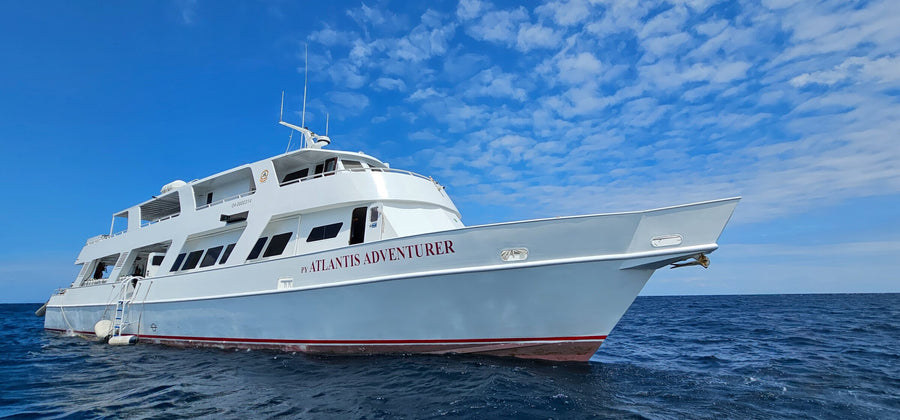
Atlantis Adventurer
Camiguin-Safari
- Indicative duration
- 7 nights
- Einschiffung
- Atlantis Dumaguete Resort, Dauin
- Ausschiffung
- Atlantis Dumaguete Resort, Dauin
No routes match this search. Try another vessel or clear your search.
Wann sollte man auf Camiguin tauchen?
Das Tauchen ist das ganze Jahr über möglich. Windrichtung, Niederschlag und die gewählte Seite der Insel beeinflussen die Planung für jeden Tag, daher sollten Sie zwischen geschützten Küstenplätzen und vorgelagerten Riffen flexibel bleiben. Die Vielfalt ist Teil der Stärke von Camiguin.
Planungszeitraum: Tauchen das ganze Jahr über.
Was Sie beim Tauchen erwartet
Wählen Sie die Inseln und Tauchplätze entsprechend der Erfahrung der Gruppe.
Riffe der Insel Mantigue
Saumriffe, Korallenhänge, Schildkröten und Fischschwärme machen Mantigue zu einem klassischen Allround-Tauch- und Schnorcheltag auf der Insel.
Burias-Bank
Ein untergetauchtes Riff mit Hängen, Wandabschnitten und Fischschwärmen, das ein stärkeres Freiwassergefühl als viele der Küstenplätze von Camiguin bietet.
Vulkanische Unterwasserlandschaften
Alte Lava, Felsformationen, steile Hänge und Riffwachstum rund um den alten Vulkan und den versunkenen Friedhof erzählen die geologische Geschichte von Camiguin unter Wasser.
Schwarze Korallen & Korallengärten
White Island und andere Plätze kombinieren Korallengärten, Lebensräume für schwarze Korallen und Riff-Fische mit dramatischen Blicken auf Camiguin über der Wasseroberfläche.
Makro- & Weitwinkel-Fotografie
Schildkröten, Schwärme und Riffszenen belohnen Weitwinkel-Fotografen, während Nacktschnecken, Frösche, Skorpionfische, Garnelen und andere kleinere Motive Makrofotografen Vielfalt bieten.
White Island & Mantigue-Oberflächenzeit
Camiguins Sandbank und der geschützte Inselpark bieten sowohl Tauchern als auch Nicht-Tauchern hervorragende Möglichkeiten für Oberflächenintervalle, Schnorcheln und Fotografie.
Tauchgänge in kleinen Gruppen
Camiguin eignet sich für einzelne Taucher, Paare und kleine private Gruppen, die eine flexible Tauchplatzwahl und einen ruhigeren Inselrhythmus bevorzugen.
Vulkane, Quellen & Wasserfälle
Hibok-Hibok, Wasserfälle, heiße und kalte Quellen sowie historische Stätten machen Tauchtage zur Fortsetzung der Expedition, anstatt sie nur als Auszeit vom Wasser zu verbringen.
DIVE SITE GUIDE
Dive sites in Camiguin
Explore the character of individual sites, from the setting and marine life to the diving conditions. Open a card for the full description; site access and the final profile depend on conditions and experience.
ORIENTATION MAP
Where the dive sites are
Use the map to understand how the key sites are spread around the destination. Pins are for trip-planning orientation only; entry points, moorings and the final dive plan are always confirmed by the local operator on the day.
Coordinates are planning references compiled from current dive-site sources. They are not navigation coordinates; entry points, moorings, tide windows and the final dive plan are always confirmed by the local operator on the day.
Reef · Wall · Offshore island
Mantigue Island
Mantigue Island is Camiguin’s best-known offshore reef and the natural choice for divers who want clear water and a more expansive reef than the nearshore volcanic sites.
Tauchplatz entdecken
- Typ
- Reef · Wall · Offshore island
- Tiefe
- 5–35 m
- Erfahrung
- Beginner–Intermediate
- Strömung
- Mild–Moderate
Mantigue Island is Camiguin’s best-known offshore reef and the natural choice for divers who want clear water and a more expansive reef than the nearshore volcanic sites. A shallow fringing reef leads into slope and wall terrain, with turtles, schooling fish and healthy coral giving the dive strong wide-angle appeal.
Depth can be adapted easily to certification, so mixed groups can stay on the upper reef while experienced divers work deeper sections. Current varies around the island and the boat normally selects the sheltered or productive side for the day. The shallow finish is especially good: after deeper scenery, divers can spend the final minutes among bright coral rather than hanging over featureless water.
Look for: Offshore island · Turtles · Coral wall/slope · Mixed-experience friendly
Ideal für: Turtles · Schooling fish · Coral reef · Wide angle
Wall · Offshore shoal
Jicdup Wall
Jicdup Wall sits on an offshore shoal where the reef drops dramatically into deep water.
Tauchplatz entdecken
- Typ
- Wall · Offshore shoal
- Tiefe
- 8–40+ m
- Erfahrung
- Advanced
- Strömung
- Moderate
Jicdup Wall sits on an offshore shoal where the reef drops dramatically into deep water. The vertical terrain gives the site a bigger, more oceanic feel than Camiguin’s protected coastal slopes, with coral and fans on the wall and room for schooling fish or passing pelagics in the blue.
Because the drop continues well beyond recreational limits, depth awareness is essential; the wall can make 30 metres feel deceptively shallow. The strongest dive is usually a controlled multilevel profile — deeper section first, then a gradual rise toward the reef top — rather than trying to follow the wall downward. It is best for experienced divers comfortable without a visible bottom reference.
Look for: Offshore wall · Deep drop-off · Wide angle · Advanced depth control
Ideal für: Deep wall · Wide angle · Pelagic potential
Slope · Soft coral · Current
Jicdup Black Forest
Jicdup Black Forest is a current-fed slope rather than a sheer wall, with soft coral and darker reef structure giving the site a distinctive look.
Tauchplatz entdecken
- Typ
- Slope · Soft coral · Current
- Tiefe
- 5–25 m
- Erfahrung
- Intermediate
- Strömung
- Moderate
Jicdup Black Forest is a current-fed slope rather than a sheer wall, with soft coral and darker reef structure giving the site a distinctive look. The moving water keeps fish active and turns the dive into a gentle drift when conditions are right, while coral heads and reef edges provide enough structure for photographers to work close to the bottom.
Stronger current can make the site more demanding, so the guide chooses entry and direction around tide. Compared with Jicdup Wall, the emphasis is less on depth and more on color and movement across the slope. It is particularly rewarding for wide-angle shooters who want soft coral and fish in the same frame.
Look for: Soft-coral slope · Drift dive · Current-fed reef · Wide angle
Ideal für: Soft coral · Drift · Reef fish · Photography
Coral garden · Reef
White Island Old Sanctuary
White Island Old Sanctuary is a shallow coral-garden dive where the attraction is time rather than depth.
Tauchplatz entdecken
- Typ
- Coral garden · Reef
- Tiefe
- 5–16 m
- Erfahrung
- Beginner
- Strömung
- Usually mild
White Island Old Sanctuary is a shallow coral-garden dive where the attraction is time rather than depth. Hard coral and reef fish fill a modest depth range, making it easy for newer divers to settle into the environment and for photographers to work with natural light.
Because most of the useful reef lies inside the first 15–16 metres, no-decompression time is rarely the limiting factor and the dive can be shaped around air consumption and interest instead. Current is usually manageable but still varies around the sandbar. It is a strong second or third dive, particularly after a deeper Jicdup profile, and a good reminder that Camiguin does not need dramatic walls to deliver healthy reef scenery.
Look for: Shallow coral garden · Beginner friendly · Natural light · Long bottom time
Ideal für: Shallow coral · Easy photography · Long bottom times
Slope · Coral · Macro + reef
White Island Black Forest
White Island Black Forest moves away from the sandbar’s shallow sanctuary into a deeper slope where coral patches, darker substrate and smaller subjects give the dive a more detailed character.
Tauchplatz entdecken
- Typ
- Slope · Coral · Macro + reef
- Tiefe
- 8–30 m
- Erfahrung
- Intermediate
- Strömung
- Mild–Moderate
White Island Black Forest moves away from the sandbar’s shallow sanctuary into a deeper slope where coral patches, darker substrate and smaller subjects give the dive a more detailed character. Divers can search the reef for nudibranchs and other macro life while still enjoying a broader coral landscape.
The profile is simple to control, with the slope providing a visible reference throughout the dive, but the deeper end can exceed the depth needed for the best subjects. A deliberate turn depth keeps the group from drifting down simply because the bottom continues. It is well suited to photographers who want a mixed reef-and-macro dive rather than a single big-animal target.
Look for: Reef slope · Macro potential · Visible bottom reference · Photography
Ideal für: Coral slope · Macro · Reef fish
Volcanic wall · Deep reef
Old Volcano
Old Volcano is Camiguin’s geology underwater: a volcanic cliff continues below the surface as a steep wall, giving the dive a dramatic vertical shape and dark-rock backdrop.
Tauchplatz entdecken
- Typ
- Volcanic wall · Deep reef
- Tiefe
- 5–40+ m
- Erfahrung
- Advanced
- Strömung
- Mild–Moderate
Old Volcano is Camiguin’s geology underwater: a volcanic cliff continues below the surface as a steep wall, giving the dive a dramatic vertical shape and dark-rock backdrop. Coral and reef life occupy ledges and sections of the face, while the open water beside the wall can bring larger fish through the scene.
The drop extends far beyond recreational limits, so the wall demands disciplined depth control even when current is mild. Divers do not need to go deep to appreciate the volcanic structure; the shallower wall offers better light and longer bottom time. For wide-angle photographers, the contrast between black volcanic rock, coral and blue water is the site’s strongest visual feature.
Look for: Volcanic wall · Deep drop-off · Wide-angle scenery · Advanced profile
Ideal für: Volcanic topography · Wall · Wide angle
Slope · Soft coral · Reef
Old Volcano Bay
Old Volcano Bay is the softer counterpart to the nearby wall.
Tauchplatz entdecken
- Typ
- Slope · Soft coral · Reef
- Tiefe
- 2–30 m
- Erfahrung
- Beginner–Intermediate
- Strömung
- Usually mild
Old Volcano Bay is the softer counterpart to the nearby wall. A gentle slope begins almost at the surface and runs through soft coral and reef habitat toward deeper water, giving divers a wide choice of depth without the psychological pull of a vertical drop.
The site is ideal for a slow photographic dive: wide-angle shooters can work soft coral and reef scenes while macro divers search the slope for smaller animals. Because useful habitat starts very shallow, the final part of the dive remains productive and there is no need for a featureless safety stop. On a calm day it suits newer divers as well as experienced photographers looking for an unhurried profile.
Look for: Gentle slope · Soft coral · Beginner accessible · Productive shallows
Ideal für: Soft coral · Relaxed reef · Photography
Historical site · Shallow reef
Sunken Cemetery
The Sunken Cemetery is one of the rare dive sites where Camiguin’s human and volcanic history is part of the underwater experience.
Tauchplatz entdecken
- Typ
- Historical site · Shallow reef
- Tiefe
- 3–15 m
- Erfahrung
- Beginner
- Strömung
- Usually mild
The Sunken Cemetery is one of the rare dive sites where Camiguin’s human and volcanic history is part of the underwater experience. Remains and submerged structures from the old coastal cemetery have become reef habitat, with coral and fish growing around features that connect the dive directly to the island’s eruptive past.
The site is shallow, so it works well for newer divers, long photo sessions and an easy final dive of the day. Visibility and marine growth vary, and the historical remains should be observed without contact or disturbance. Rather than a deep or adrenaline-heavy dive, the appeal is atmosphere: a quiet reef where cultural history and marine succession occupy the same small area.
Look for: Historical site · Shallow reef · Beginner friendly · Unique Camiguin story
Ideal für: History · Shallow coral · Photography
Unterwasserfotografie
Auf der Insel Mantigue geben Schildkröten, Fischschwärme, Korallenriffe und Weitwinkelaufnahmen einen Eindruck von den fotografischen Möglichkeiten. Wählen Sie die Kameraausrüstung für die geplanten Tauchplätze und nehmen Sie sich dann Zeit, die Szene zu beobachten, bevor Sie das Bild aufnehmen. Die Wiederholung eines erfolgreichen Tauchgangs bietet oft bessere Möglichkeiten als die ständige Suche nach einem anderen Ort. Bei Tauchgängen mit Nahfokus sollten Sie Abstand zum Grund halten und den Motiven erlauben, sich natürlich zu verhalten. Ein aufgeräumter Hintergrund und geduldiges Framing können effektiver sein als näher heranzugehen.
Auch für Nicht-Taucher: Camiguin über der Wasseroberfläche
Camiguin bietet ein umfassendes Inselprogramm: Die Wasserfälle Katibawasan und Tuasan, heiße und kalte Quellen, die Ruinen der alten Kirche und der Aussichtspunkt auf den versunkenen Friedhof bieten jeweils eine andere Perspektive auf die vulkanische Landschaft. White Island und Mantigue ergänzen das Angebot um Strände und Meerblicke.
Eine geführte Wanderung auf den Berg Hibok-Hibok ist ein anspruchsvolleres Unterfangen und verdient einen eigenen Tag. Halten Sie anstrengende oder hochgelegene Aktivitäten von Tauchgängen am Vortag getrennt und planen Sie die Reihenfolge entsprechend den nötigen Oberflächenintervallen. Leichtere Touren eignen sich gut für Begleiter, die ein langsameres Tempo bevorzugen.
Anreise nach Camiguin
Camiguin kann mit dem Flugzeug oder mit einer Kombination aus Straße und Fähre durch Nord-Mindanao erreicht werden. Balingoan ist das Fährtor zum Festland; die bessere Option hängt von Ihrem Ausgangspunkt, Ihrer Ankunftszeit und Ihren weiteren Plänen ab.
Planen Sie für die Anreise zur Insel einen eigenen Platz im Reiseplan ein. Ein Flug, eine lange Autofahrt und eine Fährüberfahrt führen zu unterschiedlichen Ankunftstagen, insbesondere mit Tauch- und Kamerataschen. Planen Sie die Inseltour und das Tauchen erst nach der Ankunft, anstatt sich auf einen sofortigen ersten Tauchgang zu verlassen.
Fragen zum Tauchen auf Camiguin
Was macht Camiguin zu einem lohnenden Tauchziel?
Camiguins vulkanischer Charakter setzt sich unter Wasser fort, von dunklen Hängen bis hin zu Riffen um die vorgelagerten Inseln. Auf einen Tauchtag können Wasserfälle, Quellen oder ein Blick auf die Berge folgen, was die Insel für einen abwechslungsreichen Urlaub ungewöhnlich attraktiv macht.
Wie sollte ich meinen Aufenthalt planen?
Wählen Sie einen Küstenstandort, der einen praktischen Zugang sowohl zu den lokalen vulkanischen Tauchplätzen als auch zu Bootsausflügen nach Mantigue oder in andere vorgelagerte Gebiete bietet. Vier bis sechs Nächte ermöglichen es, Tauchen und Landerkundungen im Urlaub zu kombinieren, anstatt die Wasserfälle erst nachträglich in Betracht zu ziehen.
Wann ist eine gute Reisezeit?
Das Tauchen ist das ganze Jahr über möglich. Windrichtung, Niederschlag und die gewählte Seite der Insel beeinflussen die Planung für jeden Tag, daher sollten Sie zwischen geschützten Küstenplätzen und vorgelagerten Riffen flexibel bleiben. Die Vielfalt ist Teil der Stärke von Camiguin.
Gibt es genug für Nicht-Taucher?
Camiguin bietet ein umfassendes Inselprogramm: Die Wasserfälle Katibawasan und Tuasan, heiße und kalte Quellen, die Ruinen der alten Kirche und der Aussichtspunkt auf den versunkenen Friedhof bieten jeweils eine andere Perspektive auf die vulkanische Landschaft. White Island und Mantigue ergänzen das Angebot um Strände und Meerblicke.
A closer look at Camiguin


Planen Sie Ihre Camiguin-Reise
Teilen Sie uns mit, welche Erlebnisse Sie am meisten wünschen, welche Daten Sie bevorzugen und wie Sie reisen möchten. Wir können das Reiseziel, die Unterkunft und das Tauchen in einem stimmigen Reiseplan zusammenfassen.
Meine Reise planen